Key Takeaways
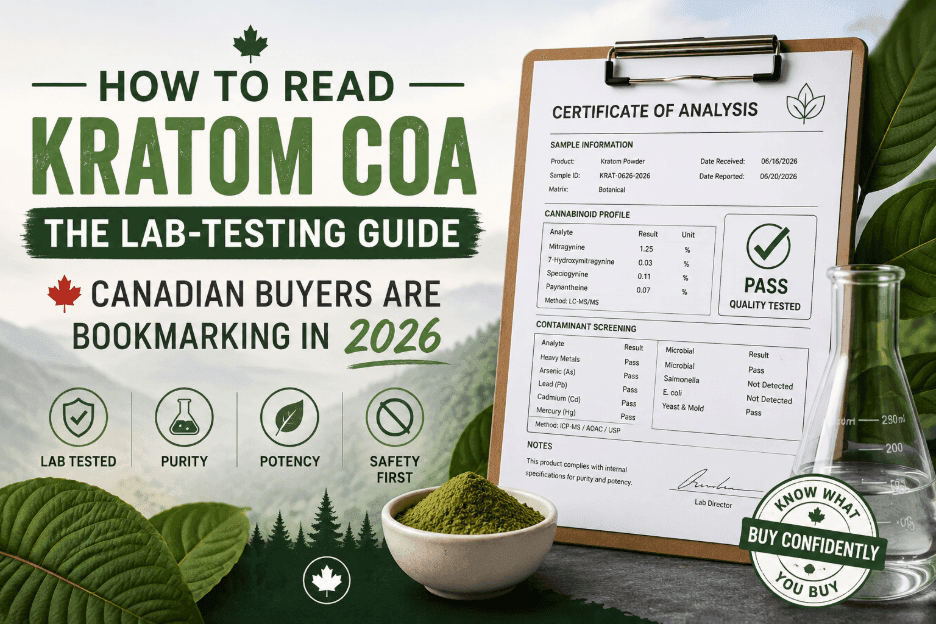
- The most crucial document that should be requested from a Canadian kratom vendor is a COA (Certificate of Analysis) – batch-level COAs are the gold standard.
- Alkaloid panels (Mitragynine %), heavy metals screening, microbiological tests, and pesticides/moisture checks should be included in COAs.
- Independent testing by an accredited third-party laboratory is much more credible than vendor in-house testing.
- Older COAs should be reviewed carefully, especially if they cannot be matched to the current batch.
- Many buyers look for vendors that provide current batch-specific COAs.
- Trusted sellers such as BC Kratom provide COAs publicly, so that customers can match the COA with the batch number on the product package.
Accessing reliable information about kratom quality has become increasingly challenging as the Canadian marketplace continues to evolve.
While many vendors claim their products undergo testing, buyers are often given little insight into what those tests actually measure or how the results can be independently verified. As a result, many botanical collectors are left comparing product descriptions without a clear understanding of the quality indicators that truly matter.
Because of this information gap, transparency has become an increasingly important consideration across the kratom industry. Rather than relying solely on marketing claims, many consumers now look for evidence that helps verify product quality, such as ingredient sourcing details, traceability records, and laboratory testing documentation.
Consequently, the demand for accessible and verifiable quality information continues to grow.
This is where a kratom Certificate of Analysis (COA) becomes valuable. A COA is a laboratory report that provides batch-specific information, including a product’s botanical profile and quality screening results. By understanding how to read a COA, buyers can move beyond marketing claims and evaluate objective testing data for themselves.
So, if you’re wondering how to read a kratom COA in Canada and what information deserves your attention, this guide will walk you through everything you need to know.
What Third-Party Lab Testing Means

Before learning to read a report, it is good to know where the information is obtained from.
Some vendors conduct internal testing using their own equipment or quality-control processes. Although this can be useful information, it is still produced by the company that sells the product. Thus, consumers can’t check those results independently.
Third party kratom testing, Canada buyers trust follows a different approach.
During this process, samples are forwarded to an external accredited laboratory that does not have any financial stake in the sale of the product. The lab tests the sample and produces a separate report presenting findings.
Since the testing organization is independent, the documentation produced is usually more credible. This is why many buyers view third-party verification as one of the strongest indicators of product transparency.
Moreover, reputable vendors also tend to match their quality programs with standards that are furthered by organizations like the American Kratom Association (AKA) and recognized GMP standards. Even though these standards are not government approvals, they may reflect an enhanced sense of commitment to transparency and quality documentation.
How to Read a COA: Section by Section
If you have ever received a lab report and got confused with technical information, you’re not alone. Luckily, a majority of the kratom reports are structured the same way.
1. Alkaloid Panel
The initial section that buyers look at is the alkaloid panel.
This table contains major compounds of the botanical material, such as Mitragynine and, in some instances, 7-Hydroxymitragynine. When analyzing a kratom alkaloid profile Canada buyers need to pay attention to consistency and documentation, instead of assuming the higher the percentages, the better the quality.
This section aims to explain the alkaloid content of a particular batch.
2. Heavy Metals Screening
The second step is to check the heavy metals section.
This panel normally screens:
- Lead
- Arsenic
- Mercury
- Cadmium
Measured levels and methodology of testing should be clearly indicated in the report. More importantly, the outcomes must match the batch mentioned in the document.
3. Microbiological Testing
Microbiological testing measures the occurrence of particular microorganisms which are regularly checked in botanical materials by laboratories.
Popular screening types comprise:
- Salmonella
- E. coli
- Yeast
- Mold
Findings and methods of laboratory analysis should be well presented in the report.
4. Pesticide Screening
Pesticide testing determines the presence of agricultural residues in the sample detected by laboratory equipment.
Not all laboratories employ the same screening panels. However, there are credible reports that explicitly reveal the materials tested and the respective outcomes.
5. Moisture Content
Less focus is usually given to moisture testing, but it is a valuable quality-control indicator.
This section quantifies the quantity of moisture in the batch during testing. When included, moisture testing can provide additional insight into quality-control practices.
Red Flags on a Kratom Lab Report
The degree of transparency in all reports is not equal.
Missing testing categories can be considered one of the biggest red flags. When a report contains only alkaloid data and not heavy metals, microbiological tests, pesticide tests, or moisture tests, additional questions can be asked.
Another issue is the outdated documentation. COAs should correspond to the batch being sold. Older reports should be reviewed carefully if they cannot be linked to the current inventory.
On the same note, ambiguity in laboratory information ought to be questioned. Credible reports recognize the testing facility distinctly and give traceable records.
The lack of batch numbers is also another red flag. In the absence of batch-level specificity, buyers cannot be certain that the report is relevant to the product they are considering.
Lastly, watch out when sellers submit one report of a complete line of products and not a particular production batch.
Why Batch-Level Testing Beats Product-Line Testing
The most widespread myth is that a single COA could be used to depict all packages sold under a product name.
As a matter of fact, botanical materials can vary from batch to batch. Laboratory results can be affected by factors like sourcing, harvesting conditions, processing, and storage.
Due to such variability, batch-level testing presents a much more precise picture of the documented properties of a product.
A product-line report can only reflect a single sample that was tested months or even years ago. In comparison, lot-specific documentation enables buyers to confirm the exact lot that they are buying.
Consequently, the gold standard of quality transparency is still in the form of batch-level testing.
How to Request a COA From Any Vendor
In case a COA is not publicly available, request it.
Start by requesting:
- The most recent batch-specific COA
- Laboratory name and accreditation details
- Testing date
- Matching batch number
Also, you need to make sure that the report contains all the major testing categories and not just the alkaloid data.
The vendor’s reaction can be a source of valuable information. Companies that embrace transparency also tend to make documentation readily available and accessible to quality information.
As an example, BC Kratom shares laboratory data in its kratom lab Test Canada reports and About Us pages, enabling customers to study quality practices prior to making a purchase.
Read Smarter, Research Better
As transparency becomes increasingly important across the Canadian botanical marketplace, understanding laboratory reports has evolved from a niche skill into an essential research tool. A well-documented kratom COA Canada buyers can review with confidence provides insight into batch-specific testing, quality-control practices, and vendor transparency.
Rather than relying solely on product descriptions, buyers can evaluate objective documentation that explains exactly what was tested and when. By focusing on batch-level reports, independent laboratories, and complete testing panels, you’ll be better equipped to assess quality information and make informed purchasing decisions in 2026 and beyond.
Explore BC Kratom’s Lab-Tested Collection
Looking for publicly available laboratory documentation?
Explore BC Kratom’s Lab Testing page to review current testing practices and learn more about the company’s quality standards. You can also visit the About Us page to understand our team’s approach to transparency, batch-level verification, and ongoing quality research.